Photo by “Mkhitar Sebastatsi” Educational Complex
Sculptor and teacher of design and contemporary art at the “Mkhitar Sebastatsi” Educational Complex, Gurgen Petrosyan, took part in the Borders exhibition with a work of the same name, and a cactus sculpture, created with the involvement of his students.
We spoke with Gurgen Petrosyan on the closing day of the exhibition.
– Could you tell us about your work?
– The work is called Borders. It’s a minimalist work in which I involved my students.
– Which grade’s students did you involve?
– Students from the 4th–5th grades of middle school, as well as from the upper grades.
– Through which subject?
– At our school, students choose, for example, art-focused groups, which they then take part in.
– Is the subject art?
– Yes, I teach design and contemporary art.
– What is it made of, and what is the idea behind it?
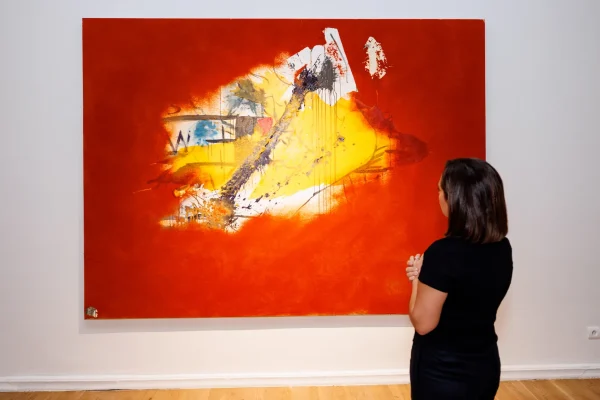
– The work is neominimalist—it’s about forms. I tried to separate the boundary between sculpture and abstract painting. In form, it resembles both a sculpture and a painting.
I combined 19 pieces into a single work. Through the choice of materials, I created a minimalist piece. Material selection is important to me: I use the cheapest, most ordinary materials- things you can still turn into a work of art. For example, in this work I used penoplex and water pipes- everyday items people usually see only as household objects.
– How long did it take you to create it?
– The actual work took about a month to complete. But there were also discussions to bring the pieces together under one concept- so that the entire exhibition would feel like a single work, rather than just a series of separate pieces.
– The discussions were held with artist-teachers. And how did you work with the children—how did you involve them?
– I explained to the children the meaning of “Borders”—what we mean when we talk about borders. The students had the opportunity to reflect on it, and those who wished to take part contributed to the creation of the work.
– Were they excited?
– Yes, very much so.
– What does involving children in a work like this give—to both you and the children?
– For me as an artist, it’s interesting. I’ve mostly exhibited in Moscow and the United States. I haven’t lived in Armenia for many years—I moved away as a student and have exhibited in museums abroad. But this is my first mature exhibition, and I decided to present it here in Armenia.
In this exhibition, I am presenting two works: in addition to Borders, I am also showcasing the Cactus sculpture.
– Did the children take part in this work?
– Yes.
– What did they do?
– We worked together, and they found it interesting. First, I explained what the sculpture was about. In the initial stage, and then in the second stage, they worked directly on the sculpture—for example, shaping the penoplex, carving these lines themselves, and working with epoxy to create the final form.
– Does your school have all those possibilities?
– Yes. Our school offers opportunities for project-based work. I created this piece together with high school students.
– Right now, the Ministry of Education is constantly talking about how important project-based work for children is. But if teachers aren’t creative and have no connection to art, is it really possible to carry out such projects so easily?
– I don’t think so. Our school has that experience—projects have been developed and implemented for about 30 years. These projects are discussed with the students, and it’s always interesting to work on them together.

Photo by “Mkhitar Sebastatsi” Educational Complex
– Could you tell us about the concept of the Cactus?
– This concept is rooted in public art- a communal sculpture that takes the form of something like a cactus. It isn’t a traditional sculpture in itself, but the artist notices its volume, its space, and so on, and turns it into a work of art. In other words, we take an object that may seem unimportant at first glance and transform it into a sculpture.
– So, by working with children in this way, you’re developing their ability to observe.
– Yes. Public art is a part of contemporary sculpture that is not yet very developed in Armenia, whereas around the world you can see many such works in public spaces—using different materials to make communal areas more engaging and interesting.
– Where will these works be after the exhibition?
– At the Educational Complex.
Interview by Anush Martirosyan.
P.S. The works of the other artist-teachers presented at the exhibition will be published soon.