Photo by “Mkhitar Sebastatsi” Educational Complex
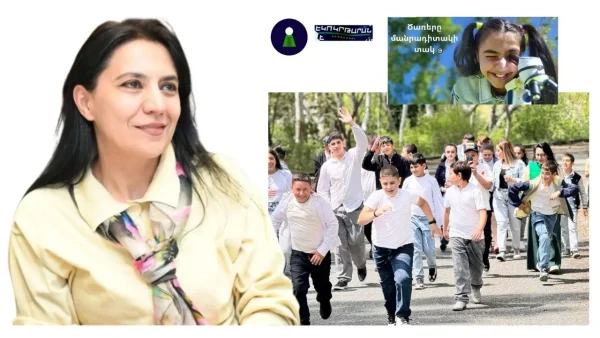
With the idea that nowadays any thought or concept quickly loses its relevance, and unresolved social issues turn into mere “patterns” or “beads,” artist Karine Matsakyan- who has been teaching art for 20 years- presented her work at the “Borders” exhibition.
The Personal in the General
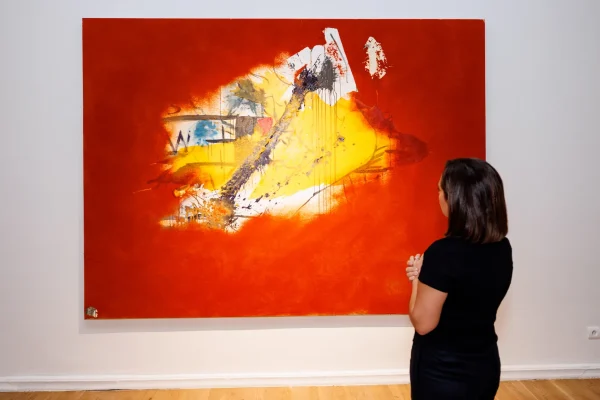
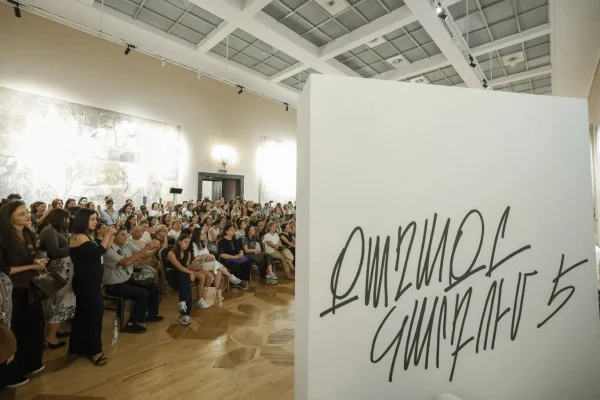
As part of the annual summer Art Festival held under the original educational program of the Art Education Center of the “Mkhitar Sebastatsi” Educational Complex, Karine Matsakyan presented a seven-piece collage at the recently concluded exhibition hosted by the Union of Artists of Armenia. This installation consists of seven sculptural pieces (30×30×40 cm each), forming a visual collage that reflects the layered reality of urban and social life. Each object represents a fragment of reality- like a slide extracted from our collective memory- ranging from a quiet coffee break to the unrest of a protesting crowd.
The materials highlight the fleeting and transparent nature of contemporary existence, where scenes shift rapidly, surviving only in memory, in the endless stream of news, or through the lens of a camera.
More than a presentation of images, the work invites viewers to feel how these everyday, often overlooked visuals inevitably infiltrate our inner world – subtly shaping our sense of reality in ways we may not always recognize.
Questions related to the social sphere become especially meaningful when explored by an artist who also teaches.
During the preparation for the “Borders” exhibition, Karine Matsakyan focused on analyzing what she calls “social patterns.” “I’ve created similar transparent works before- focused on the body, but in a social context. If our body, in a biological sense, is deprived of its social and political texture, then it is simply left to itself,” she explains.
The artist-teacher observes how a person begins to resemble a consumer product when their body- when their sense of self- starts to fade away.

Photo by “Mkhitar Sebastatsi” Educational Complex
– And did the children ask questions about this work?
– I often work on these kinds of themes with my students,” she says. “I’m interested in whether children are left to figure things out on their own or not. What do they choose?
Who are their heroes- characters from animations or films? I don’t draw a line between what’s right or wrong. For now, I’m trying to understand what their highest standard is — whether such a standard even exists today.
– And who are the heroes of today’s children? Do you have an answer?
– Of course, they look for it in TV series, because that’s where the speed is,” she says. “We belong to a generation that was more focused, always searching for meaning. For them, it’s often the victorious hero who stands out. And I want to understand that- to help them express their ideas more clearly and powerfully.
– Are today’s children different in some way?
– Today’s children are much more interesting and in tune with their time—they are stronger, faster, and quicker to learn languages and new things.
As an artist, I started working right after graduating from university. That generation- 20 years ago- was different; there were no computers yet…
– Are they more creative now, or were they more creative 20 years ago?
– Today’s children are bolder- back then, I was the one pushing them to be creative. Now, they don’t even ask what I want; they’re more in tune with modern trends. They’re deeply influenced by the idea that art should come from below, from what surrounds them in their everyday lives.
Twenty years ago, I wanted to free them, to inspire courage, to get them to notice every little thing they saw, every small detail or topic, like a button, for example. We would come up with ideas on the spot and start drawing with excitement. They began to understand that they had to draw boldly, and they were amazed, asking, ‘Is this really art?
– And what about today?
– Today, contemporary art is already absorbed into cartoons. There’s not much that needs to be explained to them. The little ones- 4 or 5 year-olds don’t need it at all, the slightly older ones do. When children draw based on what they’ve seen in cartoons, they’re searching for both the positive and the negative.
– How do you work with children?
– I play with the children—I invent things. I love to play, and they play too.
P.S. The works of the other artist-teachers presented at the exhibition will be published soon.