Photo by “Mkhitar Sebastatsi” Educational Complex
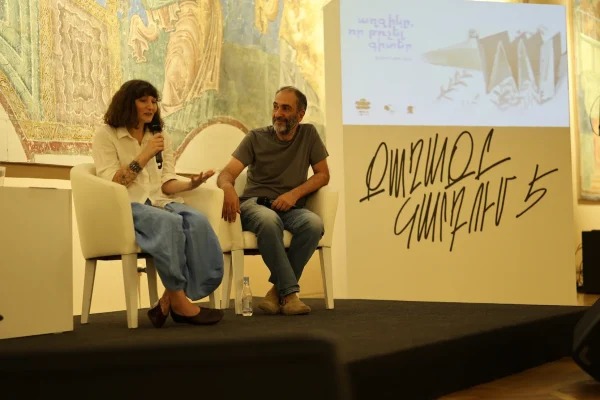
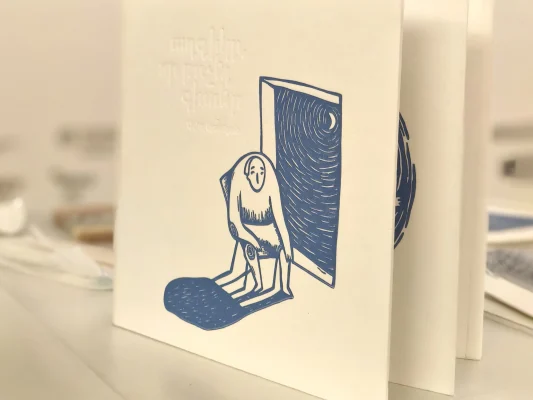
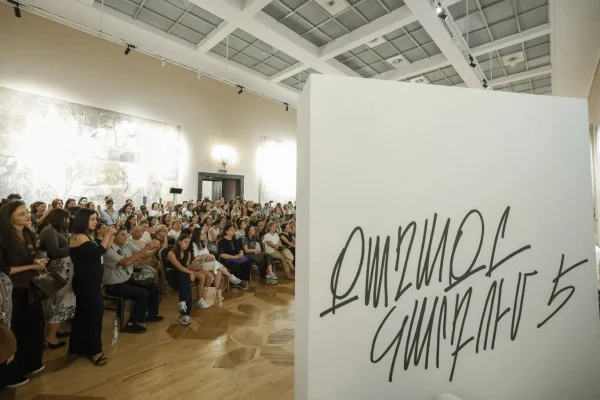
Be curious. This is the message by Martin Ålund, an artist and a representative of the “Borders” project, which was presented at the annual summer “Art Festival.” This event was organized by the Author Educational Program of the Centre for the Arts of the Mkhitar Sebastatsi Educational Complex. The exhibition brought together a group of artists from Armenia, Sweden, and France who worked with the various media. The project explored the concept of boundaries-both physical and symbolic-within the context of personal, cultural, and political identity.
Alund is an art teacher, project manager, curator, and art advisor who lives and works in Stockholm. He was educated in the Royal Swedish Academy of Fine Arts and frequently participates in solo and group exhibitions, both nationally and internationally.
Martin is also a musician who works with sound art.
Martin Alund participated in the “Borders” project, an artistic collaboration with Armenian-Swedish artist Narek Aghajanyan and Swedish artists Malin Arnedotter Bengtsson and Heidi Edström. Other Armenian artists included Gagik Charchyan, Karine Matsakyan, Gurgen Petrosyan, Guévørk Aivazian, Susan Amujanyan, Knarik Nersysian, and Narek Hakobyan. The project was supported by the Swedish Arts Grants Committee.
Photos by “Mkhitar Sebastatsi” Educational Complex and Martin Ålund
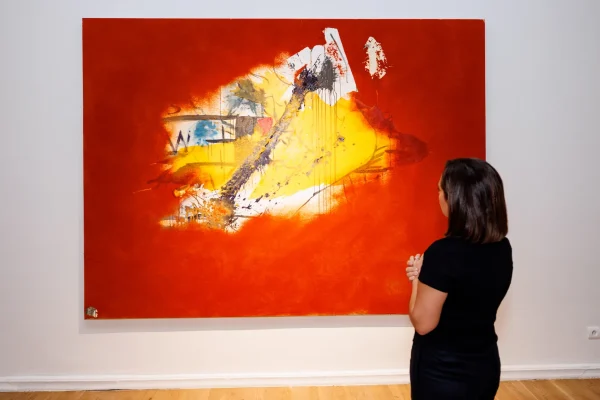
During his visit to the Mkhitar Sebastatsi educational complex in June-July 2025, Martin Alund created the painting “Mother” (Oil, acrylic, and charcoal on canvas, 200×400 cm) for an exhibition at the “Martiros Saryan” Hall of the Artists’ Union. The painting clearly shows a Nordic influence and the love for the idea of motherhood.
A winter landscape from the North unfolds before us. For those familiar with the nature of Sweden, the image is deeply recognizable-bare trees and the distinctive northern light of a sun that never quite rises above the horizon, casting a muted glow against the sky. In Alund’s large-scale painting, a dark silhouette of a woman-his mother emerges quietly. The gesture of her hand extends into a stick she is holding, suggesting an attempt to clear a path or move forward. The painting’s monumental scale evokes a sense of homeland-a memory of the North, intimate and vast at once.
Օutside of systems
Martin Alund believes that society has a lot to learn from artistic collaborations and the unique ability of artists to execute projects outside of commercial systems.
As he explained, when Narek Aghajanyan introduced the project and invited him, he decided to invite his colleagues, Malin Arnedotter Bengtsson and Heidi Edström.
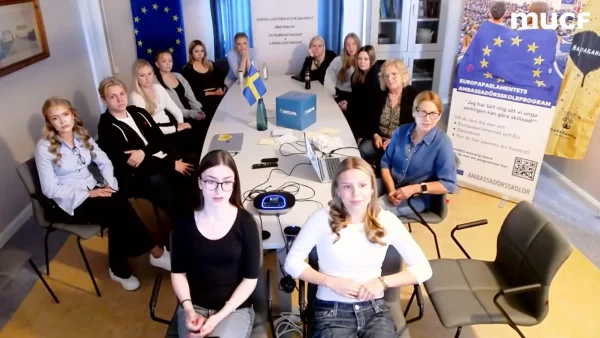
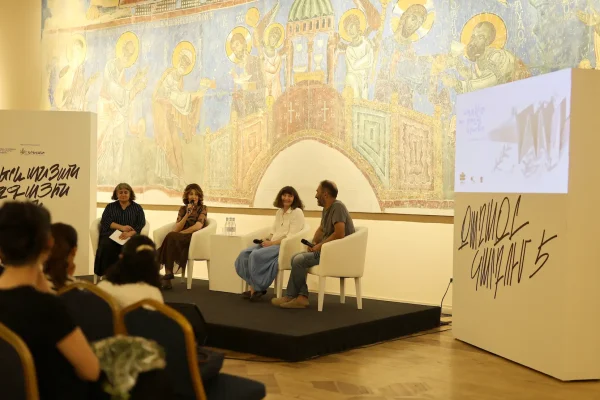
“They are performers, and it’s interesting to have both painters and performance artists because they’re really unique. It was a good idea, and then Narek connected us with this school here in Yerevan. We had monthly meetings with some of the school’s artists for a year. Those are the artists who are also participating in this exhibition and teaching at the school. They invited us to come to Yerevan to hold workshops for children, teenagers, and other teachers,” the artist said.
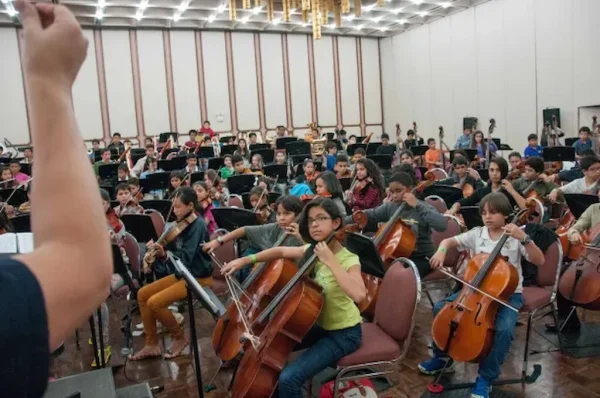
Martin Alund coordinated the music workshop at the educational complex.

Photo by “Mkhitar Sebastatsi” Educational Complex
The exhibition had a wonderful atmosphere, with Martin Alund designing the music for an installation with Guévørk Aivazian from France.
Alund, who is well-known in Stockholm, always tries to create opportunities for other artists. He once said, “There is power through art and a spiritual outlook to accept and understand the imperceptible and carry on beyond the point where sense and sensibility end”.

Photo by “Mkhitar Sebastatsi” Educational Complex
– You were living in the Mkhitar Sebastatsi educational complex?
– Yes, we were living and holding workshops in the school. I had workshops for improvisation music because I’m also a musician, while Malin and Heidi led workshops for performance art. Kids, teenagers, teachers, and artists all participated. It was a wonderful experience. I think it’s a common practice-a tradition, sometimes-for professional artists to work with kids and teenagers and collaborate with each other. I’ve worked in a similar school in Sweden, leading workshops in art for children and young adults. I did that a couple of years ago, maybe two months a year.
I’ve also taught at the Academy of Art, but those students are more grown up. Malin and Heidi have also been teaching workshops and will actually be leading a performance workshop at an art school in Sweden soon. It was really nice to collaborate with the artists here. We had meetings and talks. When you’re an artist, you often do other things besides your art, like collaborations, teaching, and other projects with fellow artists. As a painter, I’m proud of the painting I did here.
– So you created this work here in Armenia?
– Yes, I did it here in school. The school provided us with a studio, materials, accommodation, food-everything. It was fantastic. I did my painting in the studio, Malin made a sculpture for her performance, Heidi developed her performance, and Narek created his painting, which you can see over there.
– And all those art pieces will stay here-at the school?
– Yes, we will leave them here.
– Why is it important for students?
– I think art is always important for students and kids because it deals with things you can’t easily understand. It’s crucial to confront those kinds of things, as we can’t live without art and culture. It defines humanity. If you, as a kid or teenager, are exposed to culture and art on a high level, like professional artists do, you get something that you can’t get from other things. It’s like something you can’t buy with money.
– Which is for the soul.
– Yes. In society today, everything is connected to monetary value. But culture and art are above that. They’re really connected to what it means to be human-it’s an existential question, I think. Art is also something that exists all over the world; it connects people. Even if you have different opinions about art, it’s interesting because you don’t have to agree. You can have discussions and different tastes. I think art and culture are things kids and young adults really need to be confronted with, especially today, because everything is connected to material values-to be divided, to be measured. Also, for artists and cultural workers, it’s really important to be connected to kids and young people. It’s a two-way connection. You can’t just come here and say ‘this is important, you must value this.’
– Because they are more natural?
– It’s something to be curious about. Kids and young adults aren’t always curious about art, but if you connect with them, they have this curiosity about life and a sense of expectation that you can lose when you’re grown up. As an artist, you have to be curious. If you have a long practice as an artist or cultural worker, you might lose that curiosity, and you can get it back from young people. It’s a two-way street because I think that to live as a human, one of the most important things is to be curious.
– Thank you. And do you think you will come back to Armenia, and when might that be?
– We have already talked with some people here. We have to make connections. We have to bring them to Sweden. We have to come back. We have to do things together.
Before Martin Ålund’s next visit to Armenia, it is useful to remember his compelling thought: “There is power through art and a spiritual outlook to accept and understand the imperceptible and carry on beyond the point where sense and sensibility end.”
P.S. The works of the other artist-teachers presented at the exhibition will be published soon.