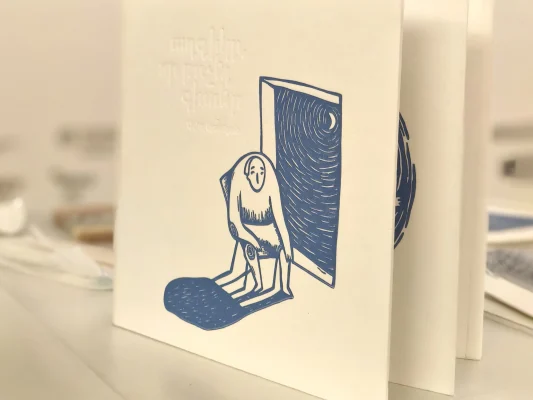
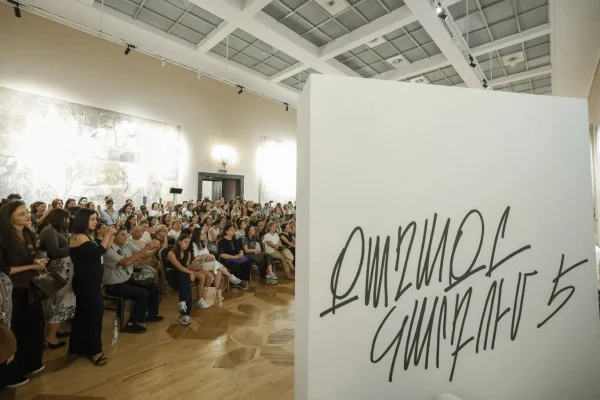
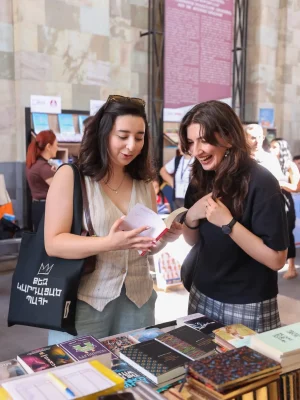
Photo by “Mkhitar Sebastatsi” Educational Complex
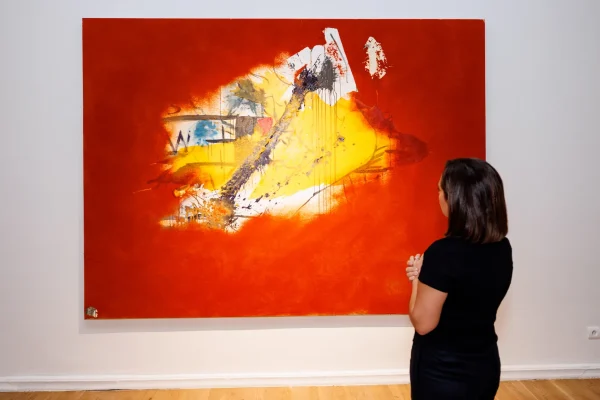
From July 8 to 11, the Art Education Center of the “Mkhitar Sebastatsi” Educational Complex also presented a video performance titled “Cleansing” as part of the “Borders” exhibition held at the “Martiros Saryan” Hall of the Artists’ Union. This compelling work was created by Knarik Nersisyan, the organizer of both the exhibition and the five-year Art Festival developed within the authorial educational program.
The aim of the project was to explore borders- both physical and symbolic, in the context of personal, cultural, and political identity.
We live in a world where borders are becoming increasingly blurred, and their meaning changes by the day.
The exhibition information sheet explained that today, art also finds itself in borderline situations. To truly focus in such moments, it is important to free the mind from distractions and go through a process of inner cleansing.
“Cleansing”

Photo by “Mkhitar Sebastatsi” Educational Complex
Knarik Nersisyan, author and organizer of the “Art Festival” at the “Mkhitar Sebastatsi” Educational Complex, presented the video performance “Cleansing” at the “Borders” exhibition. The work explores the personal process of releasing emotional pain, using the archetypal symbols of water and stone. The performance also reflects on the universal nature of women’s experiences.
It unfolds in four phases: journey, collection, cleansing, and release.

Photo by “Mkhitar Sebastatsi” Educational Complex
The suitcase, an everyday object, is transformed into a metaphysical vessel, carrying invisible burdens.
Water acts as a transformative force. The boundaries between body, nature, and viewer begin to dissolve.
Natural sounds- footsteps, water, breathing create a meditative soundscape.
The author’s meditative reflection on the video performance clearly reveals the artistic life of the Educational Complex, expressing a will to expand the seemingly fixed boundaries between organization and content.
The video performance views cleansing not as a final outcome, but as an ongoing process-one that extends outward and draws the viewer in as an active participant.
The relationship between this work and the viewer is itself a symbolic fact, directly reflecting the spirit of an educational institution grounded in art and the revelation of creative potential.
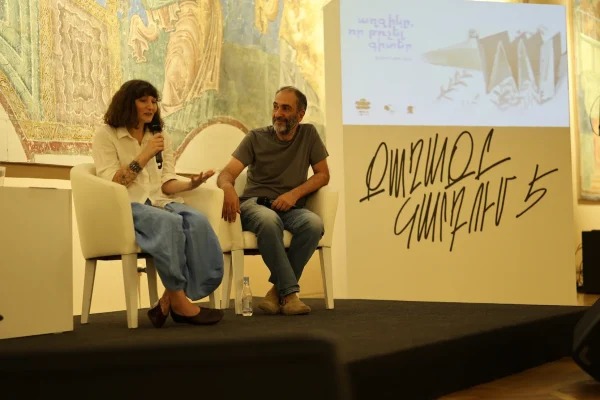
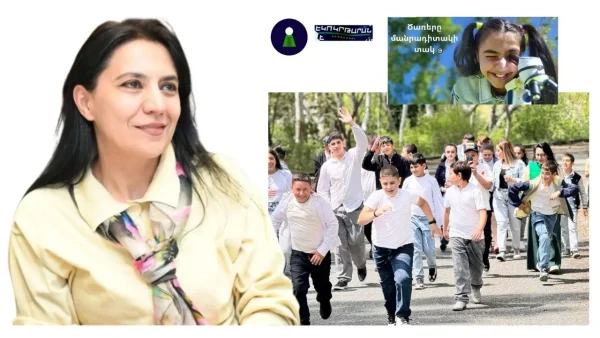
The exhibition became an opportunity to begin a conversation with Knarik Nersisyan.
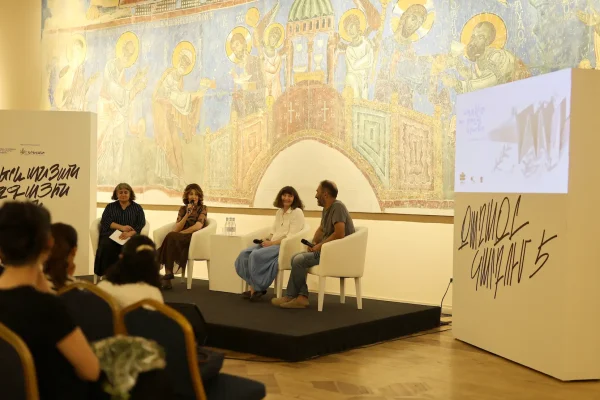
mediaforedu.am – For the past five years, the “Mkhitar Sebastatsi” Educational Complex has involved children of various ages in the Art Festival. What changes have you observed in their development, and what do children gain through art?
Knarik Nersisyan – By its nature, art is about everything, and its impact is therefore broader and deeper. The Art Festival is an important and much-anticipated event in the educational routine, as it brings together a variety of artists, both from Armenia and abroad. Our students now have equal opportunities alongside their teachers: they take part in workshops together with them, which we initiate during the festival.
In this context, our teachers are also learning. Of course, the experiences and skills gained can be applied across various projects.
We carried out the “Parajanov-100” and “Yervand Kochar-125” projects, and we can say the festival lasted the entire year, as we were also celebrating the 35th anniversary of the Educational Complex, with various workshops and the participation of different artists.
For example, Sargis Hovhannisyan.
Our mathematics teacher, together with the students, created shadow puzzles as part of the “Parajanov-100” project. These later took physical form and were exhibited in one of our exhibitions.
This is the kind of impact the festival has- participants include not only art teachers in fields like painting, design, and sculpture, but also homeroom teachers and early childhood educators. Everyone becomes involved.
As for this year, I can say that from July 1 to July 11, we held 16 workshops with 215 participants as part of the festival. There were also two lectures, concerts, performances, and excursions- we even went outside of Yerevan and carried out various research projects related to the festival. You saw the results at the Artists’ Union.

Photo by “Mkhitar Sebastatsi” Educational Complex
mediaforedu.am – “Borders” was a very interesting exhibition. It is interesting- do you share your experience with schools in the regions of Armenia? Over these five years, how many students from other schools have seen things they don’t have access to in their own schools?
Knarik Nersisyan – The number is quite large, but I’ll just highlight our most recent collaborations and experience-sharing efforts that involved an artistic component.
In the 2024–2025 academic year, we carried out educational exchanges with four art institutions, all of which were particularly interested in our authorial approach. These included the Kapan Children’s Art School, the Meghri Cultural Center, the secondary school in Meghri’s Alvank village, and the Gavar Art School. Within the framework of the Art Festival, we also collaborated with institutions from Stepanavan and Gyumri. Our cooperation with the Gyumri branch of the Academy of Fine Arts has continued for four years—both they visit us, and we visit them. The exchange of experience is ongoing and consistent.
mediaforedu.am – How important is it for the subject of Arts and Crafts to be taught meaningfully in all schools, rather than formally- just filling 40 minutes in some way? And how can children be truly engaged with art?
Knarik Nersisyan – I must return to the title of our exhibition: we need to erase the borders.
There should be no place for rigid, standardized models.
A real environment must exist- it must be created.
You have to carry it within yourself in order to be able to pass it on.
If a child doesn’t come into contact with art, I believe they don’t truly get to know life, and are not ready to step into it.
mediaforedu.am – Many schools seem tightly enclosed within walls filled with pathos. How important is it to break out of that closed environment?
Knarik Nersisyan – As you can see, our school is open- open enough to establish international partnerships. And in this case, it’s even more important to strengthen our connections within, because if you have something valuable, you should share it. I believe education is a spiritual domain, and being part of it means being able to share what you have. It’s important to build not only international connections, but also strong relationships within, so that we can support one another and contribute to a more grounded and resilient society.
P.S. The works of the other artist-teachers presented at the exhibition will be published soon.