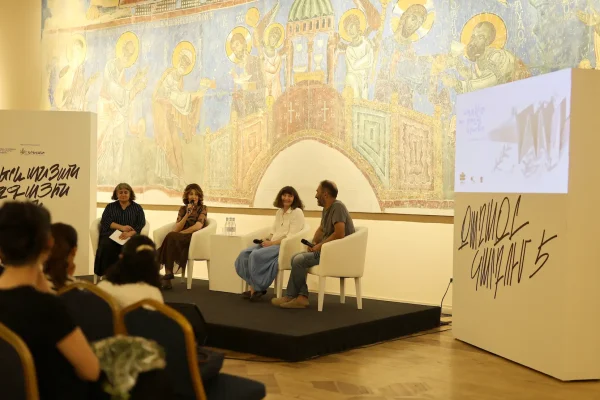
Video by Anna Grigoryan
Gevorg Ayvazyan’s participation in the Borders exhibition,organized at the Union of Artists of Armenia as part of the annual Art Festival by the Art Education Center of the “Mkhitar Sebastatsi” Educational Complex, offered a thoughtful reflection on the influence of the external world in a person’s life.
Gevorg Ayvazyan created his work within the grounds of the educational complex, surrounded by the daily rhythm of school life, the presence of children, and the educational environment. He has experience in teaching poetry and installation techniques to children.
The artist’s sensitivity toward childhood was evident both in his involvement in joint initiatives and in his choice of installation solutions.
Gevorg Ayvazyan visited Armenia for the first time last year. The opportunity arose for him to join European artists on an educational mission, aiming to share his creative vision with his compatriots. His first encounter was at the “Mkhitar Sebastatsi” Educational Complex, where he was deeply impressed by the students’ perceptions and abilities. In many ways, he discovered a new layer of Armenia through its children. The artist decided to return to Armenia to lead poetry, installation, and painting workshops at the complex. Gevorg Ayvazyan emphasizes that his work is driven both by educational goals and by the importance he places on building social connections.
“…You Must Live”
Gevorg Ayvazyan’s piece If I Must Die, You Must Live is based on the final poem of Palestinian poet Refaat Alareer. Alareer was killed along with his family in Gaza during an Israeli airstrike. In his literary will, he urged that after his death, everything he owned be sold to buy something light that glitters in the sun- a kite that would capture children’s gaze, soar high, and keep them far from all that is happening below.
A message written in another corner of the world continues through the artist’s creative work.
In the artist’s mind, protecting the lives of children remains an unwavering value—regardless of geography, circumstances, or situations.
An artist who has come to value the importance of family in Armenia was inspired to present, at the educational complex’s exhibition, a work dedicated to children in difficult circumstances- a piece that encourages cherishing the bright moments of childhood.
Gevorg Ayvazyan’s concept was accompanied by the music of Martin Allund- President of the Swedish Artists’ Association, art advisor, and musician, who also took part in the exhibition.

The Unseen, Seen
In 2019, while conducting research in Morocco, Gevorg Ayvazyan explored an object in space related to the concepts of the seen and the unseen. In the context of the Borders exhibition’s theme, his interpretation rests on the belief that these concepts originate from the formation of the universe and from astrophysical studies. However, the outcomes of his research led him to new questions, such as the memory of landscapes, the blending of elements, and humanity’s passage through these spaces, whether in search of new territories or simply for survival.
According to the artist, the aim was, on one hand, to study a wild, open area and its characteristics- the desert field adjacent to a settlement, a vast space whose agricultural cultivation had been abandoned in favor of potential construction or other uses, and, on the other hand, to focus on an object: the “Survival Blanket” or “Space Blanket.”
For the installation, six “Space Blankets” were used, each covered with two different metallic sides- gold and silver,serving different functions.
“We forget about the object’s practical use in favor of one of its inherent qualities. It’s a decisive step toward the living, enhancing the organic movement made visible through the wind.”
It was this other characteristic of the material, known as polyethylene terephthalate, that caught the artist’s attention. The present wind is also made tangible through this installation.
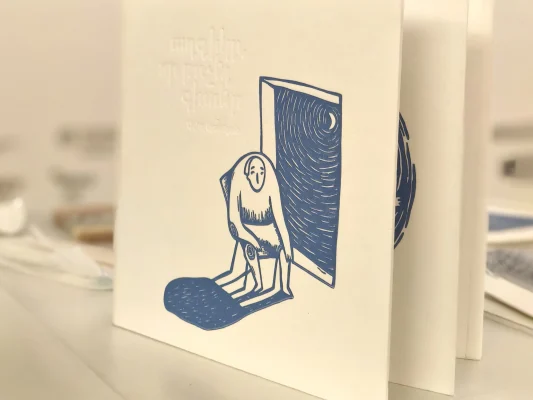
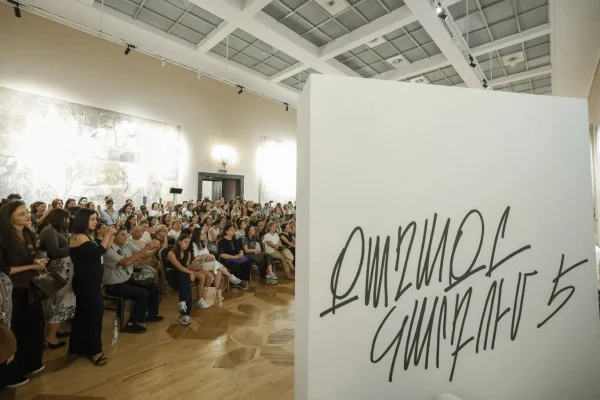
Artist’s note: “Amnesia is a trace you can see.” Ayvazyan points to an abandoned desert- land with no practical use, a space we occupy and move through. “The survival blanket works the same way: we watch the subject contracting and expanding, like in the Big Bang and in the Big Crunch- motions our universe has, in a sense, forgotten.
The artist’s journey of thought on the seen and the unseen began in Paris, as he witnessed the experiences of migrant children before his eyes.
P.S. The works of the other artist-teachers presented at the Borders exhibition will follow in sequence.