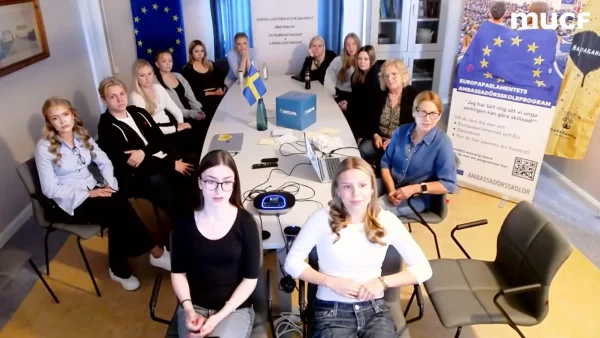
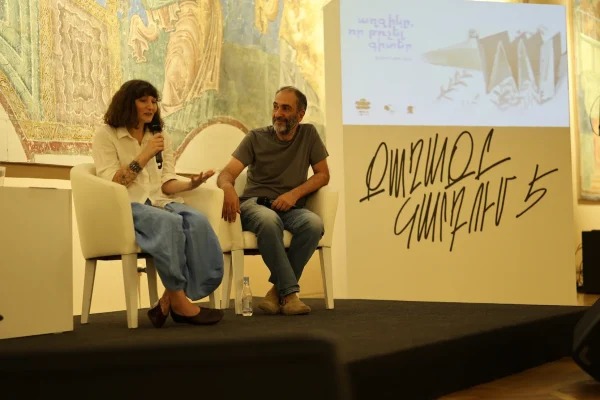
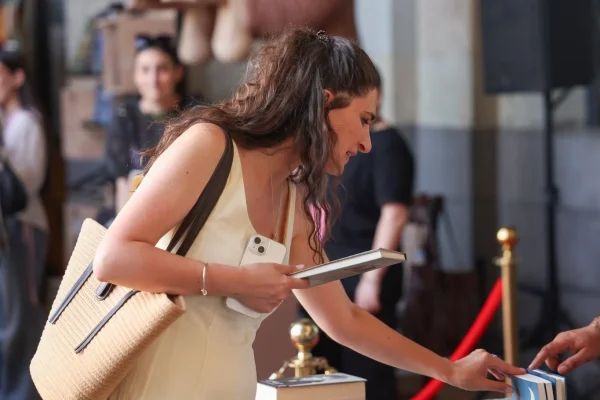
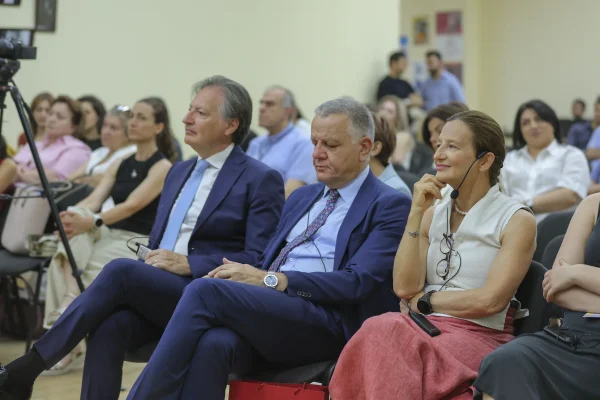
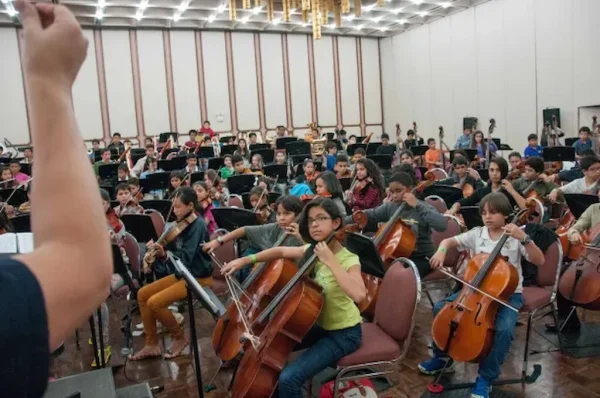
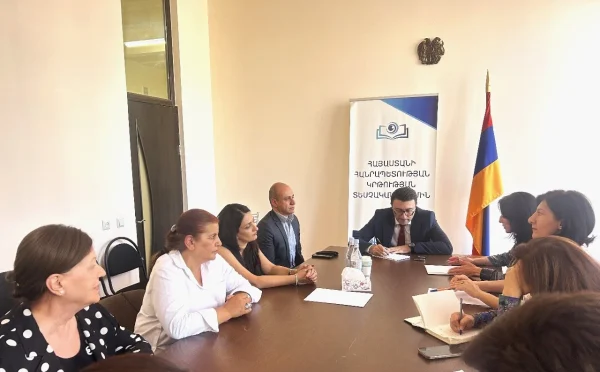
Photos by “Mkhitar Sebastatsi” Educational Complex
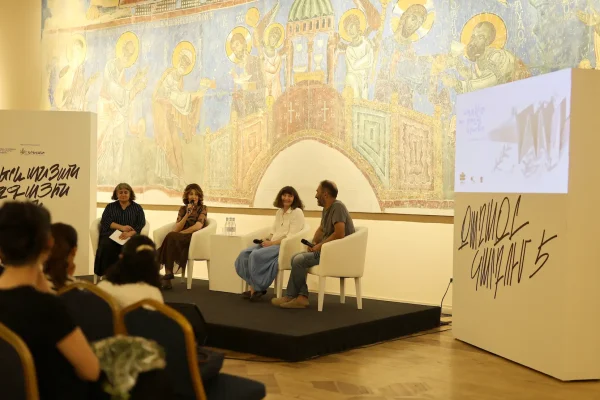
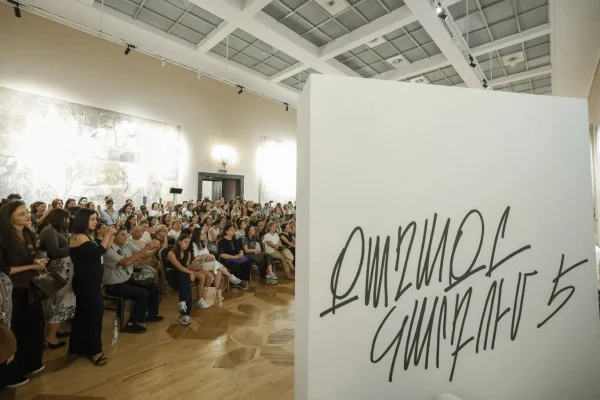
Narek Aghajanyan, an artist who came from Sweden and teaches art at a school in Stockholm, acted as a bridge between the “Mkhitar Sebastatsi” Educational Complex and Swedish artists. In his work presented at the Borders exhibition, he reflected on the invisible line between two seemingly simple notions: the homeland and the mother.
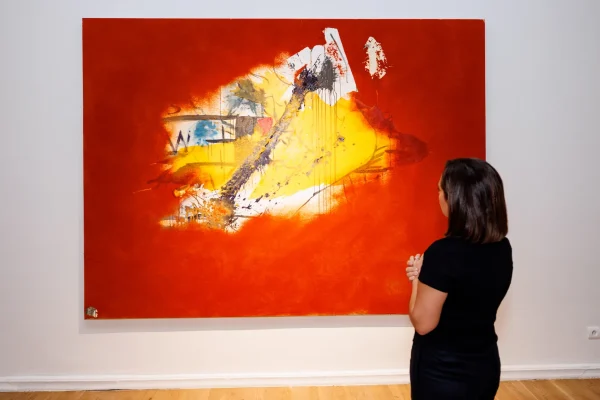
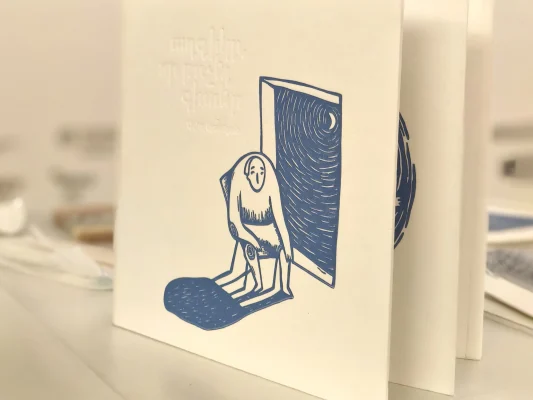
Presented in July at the Union of Artists, Narek Aghajanyan’s artwork Mother Earth symbolizes human birth- both physical and spiritual. In a time when our relationship with the planet is shifting, the artist’s message is clear: we should treat our homeland and our planet with the same care and respect as we would our own mother.
The colors of Mother Earth evoke the sunset hues of the Noravank landscape.
Narek Aghajanyan’s painting speaks for itself- it was created within the walls of the “Mkhitar Sebastatsi” Educational Complex. Our conversation with the artist revolved around the children he worked with there, during the time he was preparing, alongside European artists, for the Borders exhibition held at the Union of Artists of Armenia.
Photos by “Mkhitar Sebastatsi” Educational Complex
– Why is it important to constantly involve children in artistic activities?
– In my opinion, children are already naturally involved in art- first through their play, the creative process of their games. For them, play is always about creating, discovering, and living within their own world. Children eagerly and without resistance want to express their world, to create images in their own way, in the language of visuals. This not only supports their creative development but also contributes to their intellectual growth.

– You also work with adults. What change do you notice in creative adults- something that still exists in children but seems to fade in grown-ups? What is that?
– I’m not saying anything new when I say that children are more uninhibited, more spontaneous. Unlike adults, they don’t worry about how their actions will be perceived by society or those around them. More established artists (not all, but in my opinion, the majority) always carry in the back of their minds the question: How will this work be received? Will this or that critic like it? What will the audience think? This mindset can get in the way- it limits creative freedom. Even if you try to break free from those thoughts, you’re still thinking about others.
Unlike children, we’ve gone through school, universities, we’ve read books. All that knowledge and experience lives within us, but that “backpack” we carry- no matter how valuable, can limit our ability to create freely.
– Can good education protect us from that? And what, in your view, defines a good education
– Yes.
That idea of “good education” is understood differently across societies and geographical regions. For example, something that’s considered good education in Scandinavian countries might not be seen the same way elsewhere. But in my opinion, if we look at it broadly, education does objectively help, of course.

Photo by “Mkhitar Sebastatsi” Educational Complex
– What needs to change in Armenia so that, 10 or 20 years from now, we have people who think the way you envision?
– I haven’t lived in Armenia for 15 years. I observe from a distance, with the perspective shaped by my experiences abroad. I wouldn’t want to assume the right to give advice… But if I were to say one thing—it would be: stay open.
Connection with the outside world is important. People need to travel more and see the world. And gradually, those opportunities are growing- ur discourse is starting to connect more with global discourse. What we call “the outside world” is something very real- it’s the world where the best universities, the best galleries, and the best museums are. Anyone who finds themselves in that environment naturally wants to go there- to study, to exhibit. That kind of connection is incredibly important. It’s just as important for international professionals and artists to come here. This mutual exchange is valuable—for both us and them. I’m not saying we have everything to learn. But I’m also not saying they have nothing to learn—there’s a lot they can learn from us too.
– For example, what is it that they can learn from us?
– The people who have come here with me (from Sweden and France) are truly amazed when they encounter our culture, especially our ancient heritage, monasteries, and architecture. For them, human connection and the culture of interpersonal relationships are very important. They often experience a kind of cultural shock. But overall, they really appreciate our directness and spontaneity. For instance, in their countries, making a single decision might require multiple meetings and discussions, and even then the outcome can be delayed or misunderstood. They find our spontaneity and our practical skills genuinely fascinating.
– The challenges our people have gone through have certainly shaped these qualities.
– Yes we are problem-solvers, we tend to be more creative in everyday solutions.
– Can we say the same about children?
– I don’t interact much with children here, but when my friends were leading workshops at the “Mkhitar Sebastatsi” Educational Complex, I observed from the side and was genuinely impressed what amazing children and young people we have. They joined in right away, without any hesitation or self-doubt, and understood everything quickly. It was truly joyful to see.
P.S. The works of the other artist-teachers presented at the exhibition will be published soon.