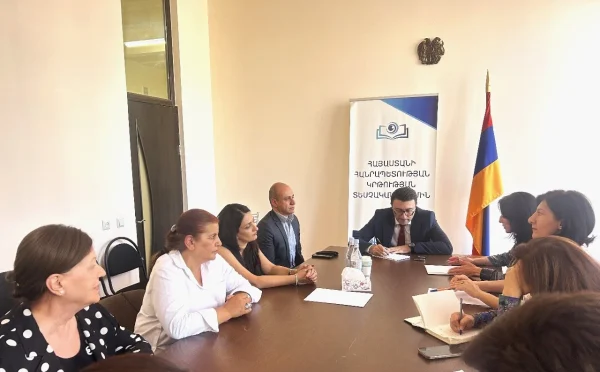
Photo by MFE
According to the 2023 order of the Minister of Education, Science, Culture, and Sports, 9th-grade students now write essays in an integrated format instead of taking oral exams in Armenian literature and Armenian history. On the same day, they write essays on two different subjects.
In 2024, the integrated exam was tested for the first time in Tavush Province.
The “Media for Education” NGO applied to the Tavush regional administration, requesting the essays written in various schools (one package each from urban and rural communities) for the purpose of an expert study.
The study of works from two different classes allows for an understanding of:
The essay, which in Armenian is also translated as “reflective writing”, is particularly widespread in Western countries. As a learning outcome, it represents the fundamental human skill of synthesizing knowledge and making independent conclusions. During the Soviet era, the equivalent of an essay was the composition, which, as an examination format, was practiced for many years in Soviet schools within the subject of literature.
However, at a certain point, it was replaced by other methods of knowledge assessment.
It may seem unnecessary to start from such a distant point, but the roots of the current issues discussed within the scope of this study actually trace back to the Soviet period.
In post-Soviet countries, it is traditionally believed that not everyone can write a composition, as it requires special talent or a gift. Clearly, this stereotype has deep roots.
Soviet culture shaped an environment where individuality was hardly encouraged. In the context of a widespread ideological crisis, thinking meant merely repeating accepted theses or opinions, nothing more.
In post-Soviet Armenia, the culture of the Soviet school still persists—not learning through discovery, but rather through copying. In this context, the freedom and opportunity to express thoughts in one’s own words and through individual reasoning are essentially blocked. This has been, and remains, a fundamental flaw of our education system.
A clear example of this is that many talented individuals showcase their abilities in various fields, but not in verbal expression, as speech, as a spontaneous manifestation of free thinking, is still not considered an educational and cultural component.
A radical shift
The new General Education Standard, which adopts competencies as fundamental concepts, emphasizes the promotion and development of critical thinking. As a result, it is planned to assess students’ level of critical thinking through examinations.
What potential risks could arise from such a radical shift, and might it be too early to implement?
It should not be forgotten that an entire generation of teachers carries the traditions of the Soviet—and, by extension, post-Soviet—education system. It would be naive to assume that teachers will suddenly break free from stereotypes and demonstrate strong critical thinking skills. Without overcoming these stereotypes, it is impossible to teach students to think independently and put their own thoughts into writing.
An entire culture must change; otherwise, the “solution” will simply be a shift from one stereotype to another. As a result, instead of producing original essays, the examination papers will turn into essay-like templates, with students merely trained and coached to follow a fixed pattern.
Trial Examination
In 2024, the integrated essay examination, tried for the first time in Tavush, included the following topics:
Literature: “Cause-and-effect relationships in Nar-Dos’s ‘Me and Her’ novel.
Armenian History: “Cause-and-effect relationships in the given passage related to ‘Nemesis’.”
Alongside the title, questions are also provided.
Assessment Criteria
At first glance, the “integration” of two entirely different topics seems strange, as they have no common ground either in terms of the time period or thematic emphasis.
As a result, the student ends up writing an exam essay on the same day on two different subjects on completely different topics.
How logical is this, and where is the integration in this situation—it’s unclear. The assessment criteria are quite ambitious and difficult to measure with a point-based scoring system.
It is unclear why literacy is not given any points, while the demonstration of an intersecting concept is required—something that is still not clearly understood by teachers, let alone by students.
In the case of the literature subject, the questions only partially align with the title’s content (the questions address only one of the story’s characters, while the title itself does not suggest such a limitation).
Analysis of Essays
While promoting critical thinking is undoubtedly a positive goal, it is equally important to approach it carefully and thoughtfully to avoid it becoming artificially imposed, replicated, or lacking in spontaneity. Unfortunately, the examination essays from two different locations and classes reveal some strikingly similar shortcomings: the content is largely reproduced, and instead of presenting arguments and reasoning, they predominantly contain emotional statements.
The predominant feature is guided, non-original thinking, as evidenced by the presence of identical sentences in different essays from the same class.
Let’s try to elaborate with examples:
Subject: Literature
Subject: History
Conclusion
In the story “Momo” by the German writer Michael Ende, known for his wonderful works for children and adolescents, there is an interesting episode: Little Momo, enchanted by the beautiful speech of her older friend, says that she, too, would like to speak that way. “You can’t,” replies her friend, “those words still need to grow inside you.”
Every age has its own way of expressing thoughts, and nurturing these words requires an environment—texts that are age-appropriate, simple but not simplistic, that do not restrict freedom of thought or impose ideas, and that are artistically refined. Words gain strength through lived experiences, and if they are merely injected instead of naturally maturing, we cannot expect to hear coherent speech or read essays filled with original ideas and clear structure.
Our education system still has a long journey of self-improvement ahead before it can truly embrace the demand for critical essay writing. I believe it is still too early to make it an examination requirement. Intermediate solutions can always be found.
Teacher
MFE Co-founder